Guides
Writing an episode outline that generates well
An outline generates well when each scene fits its share of the runtime, happens in one approved place with approved characters, and states a purpose and a few beats a camera can see. In Animey you write the premise and pick the length, the AI writes the acts and scenes, and you tighten, reorder or rewrite them before a single shot is generated.
By the Animey team5 min read
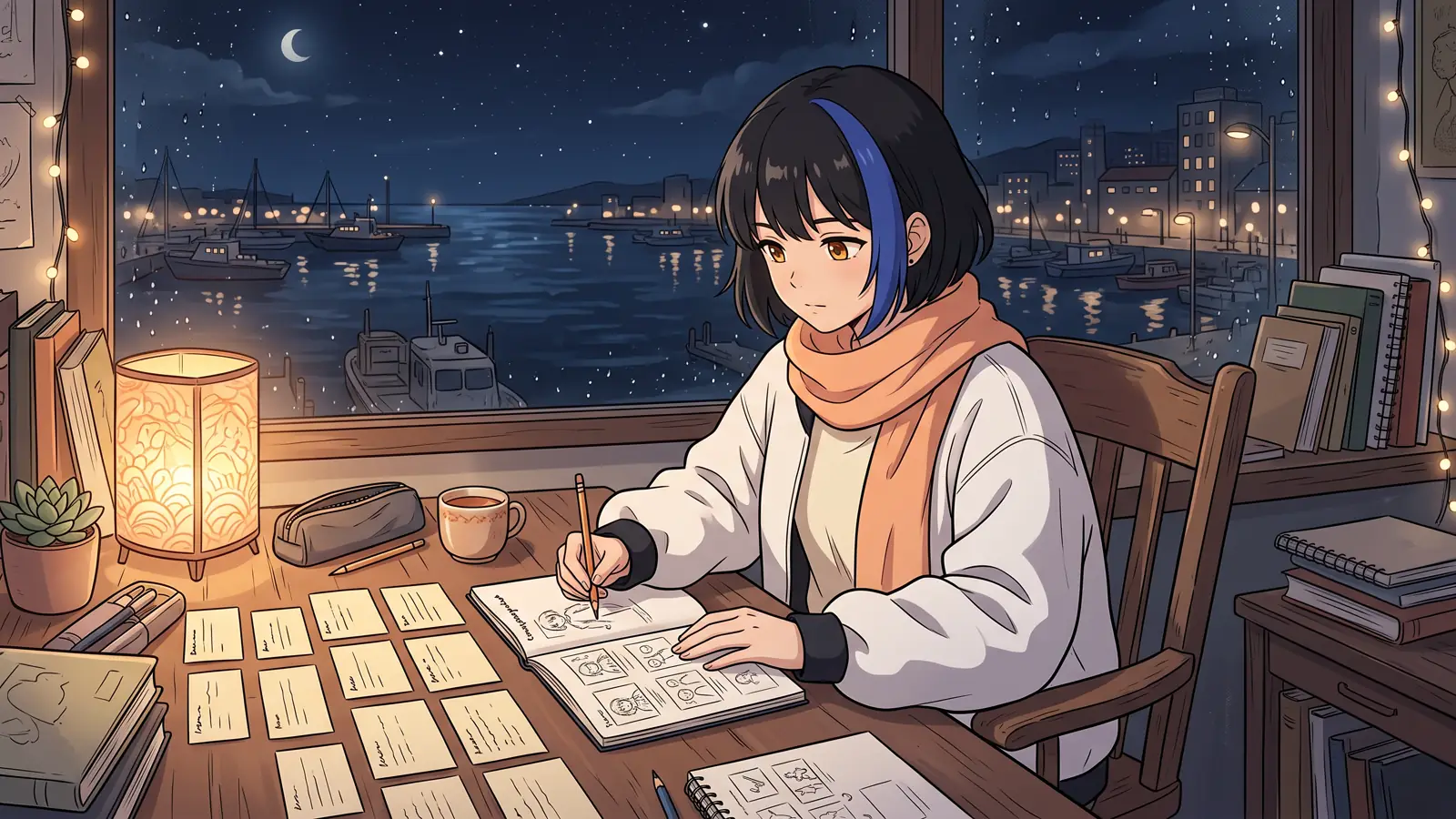
The outline is where an episode is won or lost. It decides how many scenes there are, where they happen, who is in them and what each must achieve, and every script, shot and credit afterwards follows from it. This guide explains how Animey, an AI anime studio by Softforge Digital, writes an outline and how to steer it, as of October 2026.
What the outline holds
When you plan an episode, you give a premise of a few sentences, or ask Animey to continue the story, a runtime of 1, 3, 5 or 10 minutes and a tier. The writer answers with a title, a logline of one or two sentences and up to five acts. Each act holds scenes, and each scene has six parts:

- a place, one of the series’ locations, or none;
- a time of day, day or night;
- a cast of up to eight characters;
- a purpose, one or two sentences on what the scene does for the story;
- two to five beats, the moments it shows, in order;
- a music mood for the scene’s music bed, or silence.
The length sets the number of scenes
| Runtime | Scenes | Screen time per scene |
|---|---|---|
| 1 minute | 2 to 3 | 20 to 30 seconds |
| 3 minutes | 3 to 6 | 30 to 60 seconds |
| 5 minutes | 5 to 8 | 38 to 60 seconds |
| 10 minutes | 8 to 14 | 43 to 75 seconds |
A scene’s share of the runtime is what its script and its shots are sized for. At about one line every five seconds, a 30-second scene holds five or six lines; an argument that needs more needs a longer scene, or two scenes. The trial makes episodes of one minute; longer runtimes need a plan.
Six steps to an outline that generates well
Step 1
Approve the cast and the places first
The outline writer only casts approved characters, and shots can only be generated in approved locations. Approve the characters and places the episode needs before you plan it; the writer cannot cast a character it is not given.
Step 2
Write a premise that states a change
Say who wants what, what stands in the way and what is different at the end, in three to five sentences. “Tamsin must carry a sealed letter across the flooded city before the bell tower rings, and the courier who lost it tries to stop her” gives the writer more to stage than a mood or a theme.
Step 3
Keep each scene in one place and one time
A scene is drawn against one location’s plates at one time of day. If the action moves from the rooftop to the street, that is two scenes. A night scene needs the location’s night plates, a second set for 1 credit.
Step 4
Write beats a camera can see
“She realizes he lied” is hard to draw. “She finds his train ticket in the drawer and slips it into her pocket” is two clear shots. Visible beats become clear actions in the script and clear keyframes on the board.
Step 5
Keep casts small
A scene can hold eight characters, but everyone in a shot shares one budget of reference images, so two or three characters per scene draw more reliably than eight. Why sheets matter explains that budget.
Step 6
Rewrite before you generate
Edit the logline, the acts and each scene card by hand, drag scenes into a new order, or use Rewrite with AI with an instruction such as “make the second act quieter”. A rewrite replaces every scene and its script, and once a shot of the episode has a take, Rewrite with AI is blocked: the logline, the acts and the scenes stay editable by hand, but big changes are easiest before you generate.
Continuing a series
From the second episode on, the planner offers to continue the story. The writer then reads up to twelve previous episodes through their recaps: a three-sentence summary written when an episode is rendered, or its logline if it has not been rendered yet. Render an episode before planning the next, and the next outline starts from what actually happened on screen.
Stay inside the rating
The writer follows the series rating. All ages means no blood, no death on screen and nothing more frightening than a children’s adventure; teen allows stylized action and peril, never gore. No rating allows sexual content, and every premise, outline and script is checked before it is stored. The drawing and motion prompts written for each shot are checked again, and a video provider’s own filter can also refuse a shot, so a premise written inside those limits is rarely refused later, and a shot refused during generation returns its credits.
Published after launch. We will measure this on real episodes and add the figure here, with its date.
Source: Animey usage data, first quarter after launch
Next come the scripts and the shots: the pacing guide shows how a scene becomes shots of 5 to 10 seconds, and the one-afternoon guide puts every step in order.
Questions this answers
- How many scenes should an AI anime episode have?
- In Animey, the outline writer plans 2 to 3 scenes for a one-minute episode, 3 to 6 for three minutes, 5 to 8 for five and 8 to 14 for ten. Each scene gets its share of the runtime, and never less than 10 seconds.
- Can I write the outline myself?
- Yes. The AI writes a first outline from your premise, then you can edit the logline, the acts and the scenes, add, delete and reorder scenes, or ask for a rewrite with an instruction. Once a shot has a take, the AI rewrite is blocked, but hand edits remain possible.
- Why does my character not appear in the outline?
- The outline writer only casts approved characters. Approve the character’s reference sheet, then rewrite the outline or add the character to a scene by hand.
- How does Animey keep continuity between episodes?
- With “continue the story”, the writer reads up to twelve previous episodes through their recaps, which are written when each episode is rendered. The characters, locations and style card stay the same from one episode to the next.
Start your own series
Describe your world, cast your characters and plan your first episode, scene by scene.
Start free