Explainers
Copyright, likeness and AI anime: what you may and may not create
With Animey you may create original characters, worlds and episodes from your own ideas and sketches and use them under Animey’s terms, but you may not depict real people, clone voices, reuse characters and franchises that belong to someone else, or ask for the style of a named studio or artist. This article explains those rules and the legal background as of September 2026, and it is general information, not legal advice.
By the Animey team6 min read
Animey, an AI anime studio by Softforge Digital, is built for original series. Its rules are enforced by the product, not only written in the terms: prompts, bibles, scripts and sketches are checked before anything is generated. Knowing the rules saves refused prompts, and knowing the legal background helps you decide what to publish and how.
What you may create
- Original characters, worlds and stories, however familiar their genre: magic schools, space pilots, detective duos and haunted lighthouses belong to no one.
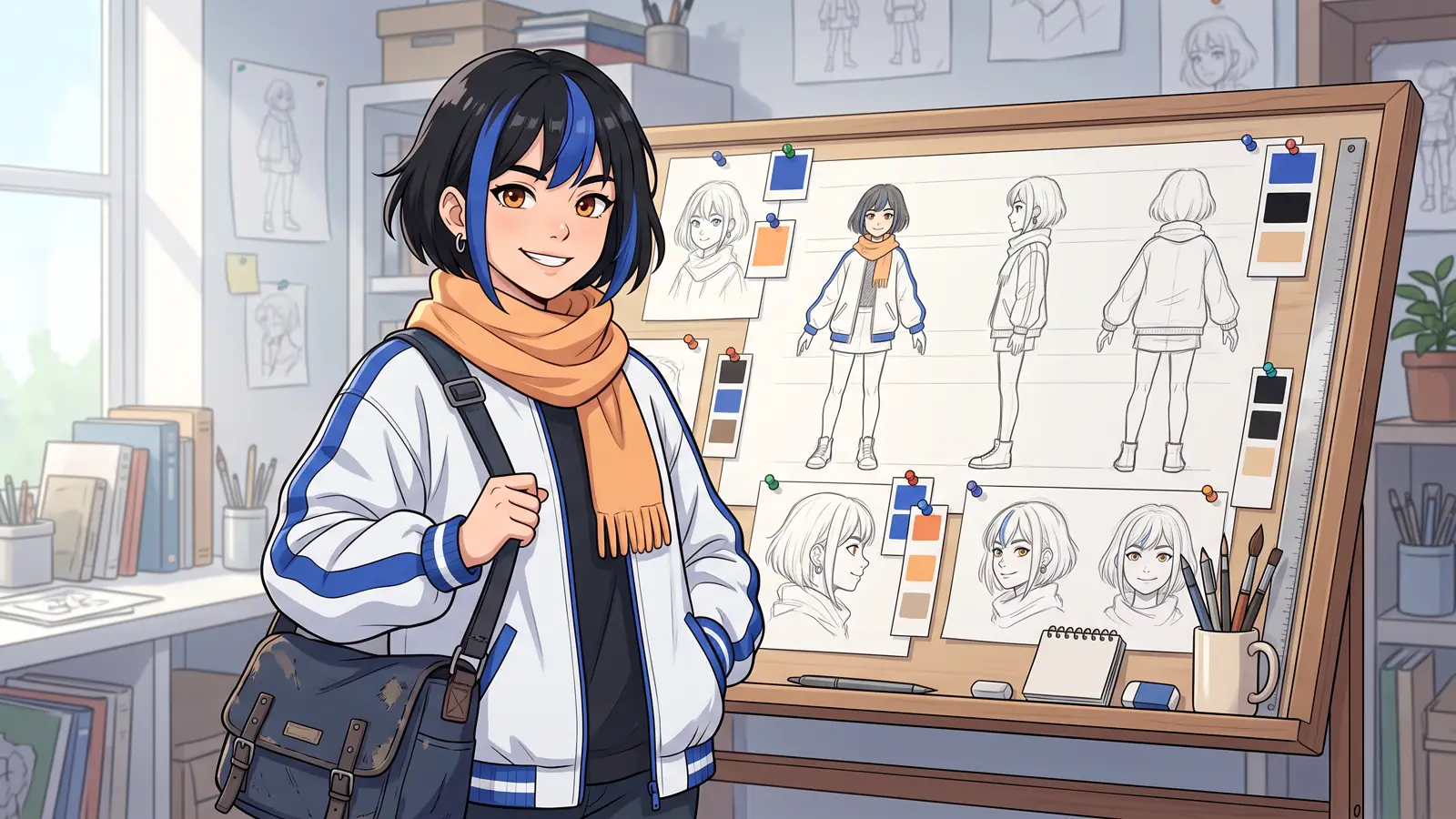
- Characters from your own drawings: you can upload a reference sketch that is yours to use, and Animey draws the character in your series style.
- Episodes in any of the eight generic art styles, in any dialogue language Animey voices, rated all ages or teen.
- Your own projects, commercial ones included, under the conditions of Animey’s terms of service.
What Animey refuses
- No real people. Characters and sketches that depict or describe an identifiable real person, a public figure or a face photo are refused, whatever the purpose, parody and tribute included.
- No existing characters or franchises. Prompts that name or unmistakably describe someone else’s character, series or world are refused, and so are requests for the style of a named studio or artist.
- No voice cloning. There is no voice upload and no cloning route: every voice comes from a curated library of licensed AI voices or is designed from a written description, and a description of a real person’s voice is refused.
- No sexual content, in any form and at any rating, and no gore, torture or self-harm. Violence stays stylized and within the series rating.
A refusal names the category that was matched, so you can rewrite the prompt. The checks are automated and imperfect: they can block something acceptable and miss something that is not, and a refusal is never routed around through another model. Staying inside the rules remains your responsibility.
What you upload must be yours
Animey accepts one kind of upload: a reference sketch of a character, as a PNG, JPEG or WebP image of up to 10 MB. There is no audio or video upload anywhere in the product. By uploading a sketch you confirm, under the terms, that you own it or have the right to use it, and it is checked before use: a sketch of someone else’s character, or a photo of a real face, is refused.
The legal background, as of September 2026
Copyright law was written for human authors, and countries are still deciding how it applies to AI output. Three developments are worth knowing, with their dates:
- In the United States, the Copyright Office concluded in its January 2025 report that prompts alone do not make you the author of what a model generates, while human-authored parts, such as your own text and the creative selection, arrangement or modification of material, can be protected.
- In the United Kingdom, section 9(3) of the Copyright, Designs and Patents Act 1988 makes whoever arranged for a computer-generated work, one with no human author, its author, and section 12(7) protects it for 50 years. A government report of 18 March 2026 proposed removing that protection; no legislation had followed by September 2026.
- In the European Union, the transparency rules of the AI Act (Article 50) have applied since 2 August 2026: providers of generative AI systems must mark their output as AI-generated in a machine-readable way (Article 50(2), by 2 December 2026 for systems already on the market), and anyone using such a system professionally to make a deepfake must disclose it (Article 50(4)), more lightly for evidently artistic or fictional work.
The Commission’s code of practice, final since 10 June 2026, shows how such content can be marked and labeled. Its Article 50 guidelines, approved on 20 July 2026 (C(2026) 5054), do not treat AI voices for fictional characters, in animation for example, as deepfakes when nobody is misled about who is speaking.
In practice, the more of the creative work is yours, the stronger your position. Your premise, your scripts and dialogue, your choice of takes and the order of your scenes are human contributions, and a character drawn from your own sketch starts from your work. Keep your drafts, and do not assume that a generated image is protected on its own.
Two other rights sit next to copyright. Trademarks protect names and logos used in trade, so do not give your series or your characters the name of an existing brand. Likeness and personality rights protect a person’s face, voice and name in many countries, which is one reason Animey refuses real people outright instead of judging each case.
AI disclosure
Animey’s own rules come first. Its acceptable use and AI disclosure policy asks you to keep each file’s metadata, leave the trial watermark alone and use the platform’s AI label wherever one is offered, and its terms make disclosure your responsibility as the publisher.
Animey adds a courtesy disclosure: every MP4 carries the comment “AI-generated with Animey” in its metadata. End credits, on by default and always on the trial, close with the same line, and trial renders add a “Made with Animey” line and a small watermark; both lines are translated in French and Arabic episodes.
The platforms’ own rules, checked in September 2026, are narrower. YouTube requires disclosure for realistic AI content, not for clearly unrealistic content such as animation, but may add a label itself. TikTok requires a label on AI content showing realistic people or scenes, accepts its own AI-generated label or a clear caption, sticker or watermark, and may also label content itself. An anime episode may need no label under those rules, but Animey’s still ask for one. The export guide covers the upload settings.
Published after launch. We will measure this on real episodes and add the figure here, with its date.
Source: Animey moderation data, first quarter after launch
Questions this answers
- Can I make fan anime of an existing series with Animey?
- No. Animey is for original series: prompts that name or unmistakably describe an existing character, franchise or studio style are refused. Create your own characters instead, even in a familiar genre.
- Can I put a real person, or myself, in an Animey episode?
- No. Characters and sketches that depict an identifiable real person, including a photo of your own face, are refused, and there is no voice cloning. Design an original character inspired by an idea rather than by a person.
- Who owns an anime episode made with Animey?
- Animey claims no ownership of your series, and its terms of service set out how you may use what you make. Whether AI output is protected by copyright depends on your country and on how much of the work is yours, so keep your scripts and drafts.
- Do I have to label my episode as AI-generated?
- Yes, under Animey’s rules: keep the file’s metadata and use each platform’s AI label wherever one is offered, because disclosure is the publisher’s responsibility. YouTube and TikTok themselves require labels mainly for realistic content, and may add one on their own.
- Is this article legal advice?
- No. It summarizes Animey’s rules and public legal developments as of September 2026. For a decision about your own project, consult a lawyer in your country.
Start your own series
Describe your world, cast your characters and plan your first episode, scene by scene.
Start free