Explainers
Giving a character a voice: library voices, designed voices, and why we never clone
In Animey, each character gets one voice per dialogue language, either picked from a curated library of licensed AI voices, many recorded with professional voice actors, or designed from a written description, which returns three candidates for 1 credit. Animey never clones a voice: there is no audio upload and no cloning feature, because a voice identifies a real person and an original character deserves an original voice.
By the Animey team5 min read
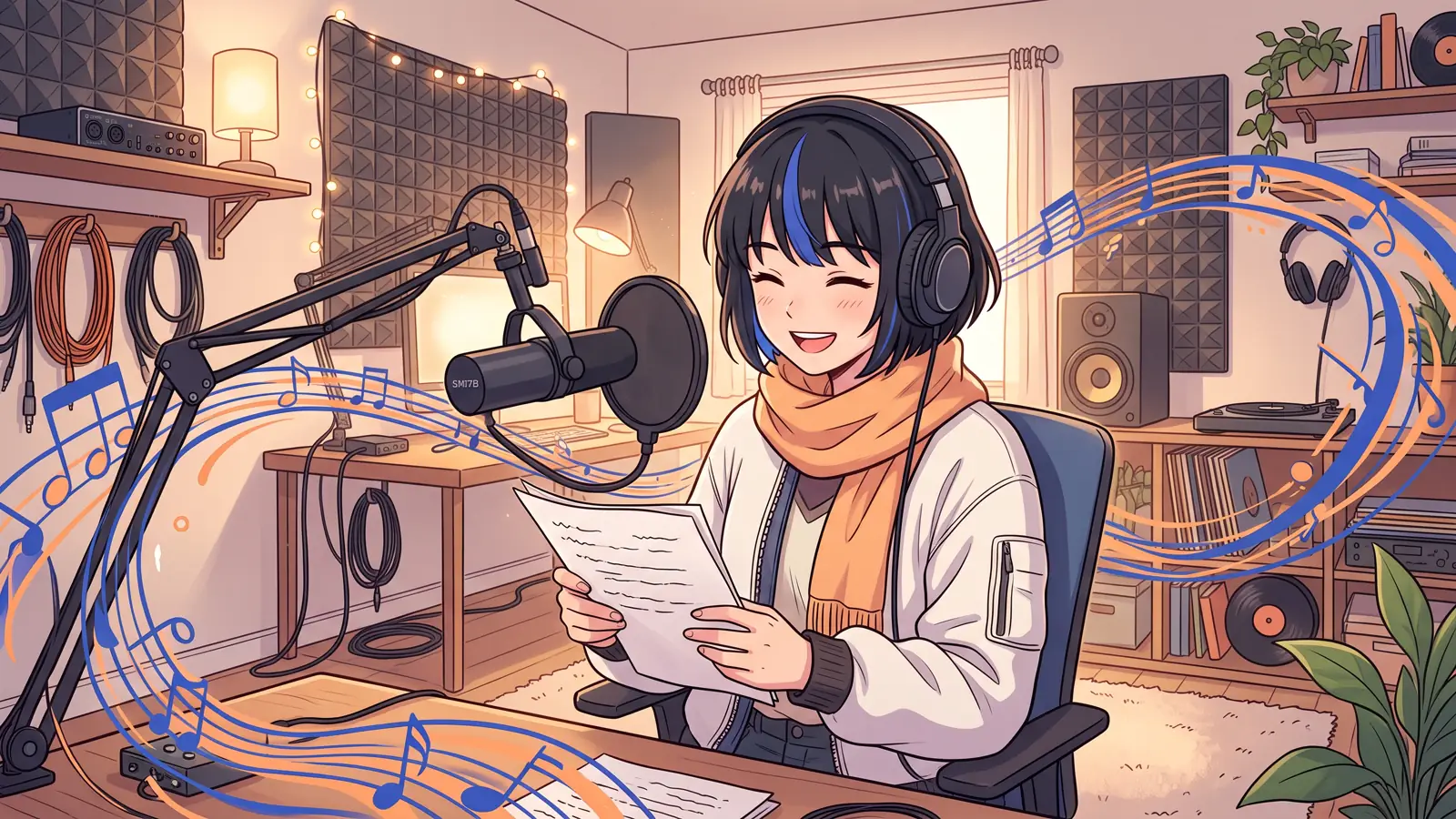
A voice does half of a character’s acting. This explainer shows how voices work in Animey, an AI anime studio by Softforge Digital, as of October 2026: where they come from, how lines are delivered and timed, and why the product deliberately has no voice cloning.
One voice per character, per language
Every series has a dialogue language, chosen when you create it, and Animey voices 29 of them, including English, French, Arabic, Japanese, Spanish, German, Korean and Portuguese. Each character gets one voice in that language, and the same voice speaks every line the character says, in every episode. Voices are kept per language, so if you change the series’ dialogue language, each character needs a voice in the new one.
The dialogue language is independent of the interface: a series can speak Japanese with English subtitles while you work in French, and each episode can carry subtitle files in its dialogue language and up to three others.
Library voices
The library is a curated set of licensed AI voices chosen for anime characters, many of them recorded with professional voice actors. Filter it by gender and by apparent age; each voice shows tone tags such as bright, calm, deep, gravelly, playful or warm, and you can play a sample in your dialogue language before you choose. Picking a library voice costs no credits. Library voices are shared, though: another creator can pick the same one.
Designed voices
Voice Design creates a new synthetic voice from words. Describe the sound, not a person: age, pitch, texture, pace, accent and energy, in at least 20 characters. Animey starts from the voice description in the character bible, so a well-written bible gives a good first design. Each design costs 1 credit and returns three candidates to listen to; keep the one you like and name it. Discarded candidates cannot be played or kept again, and a design that fails returns its credit. A designed voice is not reserved for you either: Animey’s terms of service say that library and designed voices can be heard in other people’s series.
| Question | Library voice | Designed voice |
|---|---|---|
| Cost | No credits | 1 credit for three candidates |
| Where you start | Filters and samples | A written description of the sound |
| Languages | The languages it was checked in | The language you design it for |
| Best for | Supporting roles and quick starts | Leads, children, teenagers, unusual timbres |
How lines are delivered
Every line in a script has a speaker and an emotion: neutral, happy, sad, angry, afraid, surprised, determined, playful, tender, whispering or shouting. The emotion shapes the delivery when the line is voiced. Animey voices each line during generation, records when every word is spoken, and uses those timings twice: to set how long the shot lasts and to time the subtitles word by word.
At the Standard tier, the voice is laid over the animation, whose motion prompt asks the speaking character’s mouth to move while they speak. At the Reference tier, the voiced line is sent to the video model along with the images, which is designed to make the lips follow the actual dialogue. Use it for the lines that matter most.
Why we never clone
Voice cloning copies a real person’s voice from a recording. Animey leaves it out on purpose, for four reasons:
- A voice identifies a person. Many countries protect it as part of a person’s likeness, and consent cannot be verified from an uploaded file.
- Copied voices are a tool for impersonation and fraud, a risk an anime studio has no reason to take.
- Original characters deserve original voices, designed from a description of a sound rather than copied from a real person.
- The safest feature is the one that does not exist: Animey has no audio upload at all, so there is nothing to copy from.
The same rule applies to descriptions: a Voice Design request that names a real person, or asks to sound like one, is refused. What you may and may not create covers the other likeness rules.
Published after launch. We will measure this on real episodes and add the figure here, with its date.
Source: Animey usage data, first quarter after launch
Voices shape pacing as well: shots, cameras and pacing explains how spoken lines set the length of a shot.
Questions this answers
- Can Animey clone my voice or a famous person’s voice?
- No. Animey has no voice cloning and no audio upload. Voices come from a curated library of licensed AI voices or are designed from a written description, and descriptions of real people’s voices are refused.
- How much does a character voice cost?
- Picking a library voice costs no credits. Designing a voice costs 1 credit for three candidates, and a design that fails returns its credit.
- Can a character speak Japanese with English subtitles?
- Yes. The dialogue language of a series is independent of the interface, and each episode can carry subtitle files in its dialogue language and up to three others, translated from the voiced lines.
- Do the characters’ lips match the dialogue?
- At the Reference tier, the voiced line guides the animation, which helps the lips follow the dialogue. At the Standard tier, the voice is laid over an animation in which the speaking character’s mouth moves, which works well for short lines.
Start your own series
Describe your world, cast your characters and plan your first episode, scene by scene.
Start free